Salary vs. Net Pay: How to Calculate Take-Home Pay After 401k & Taxes
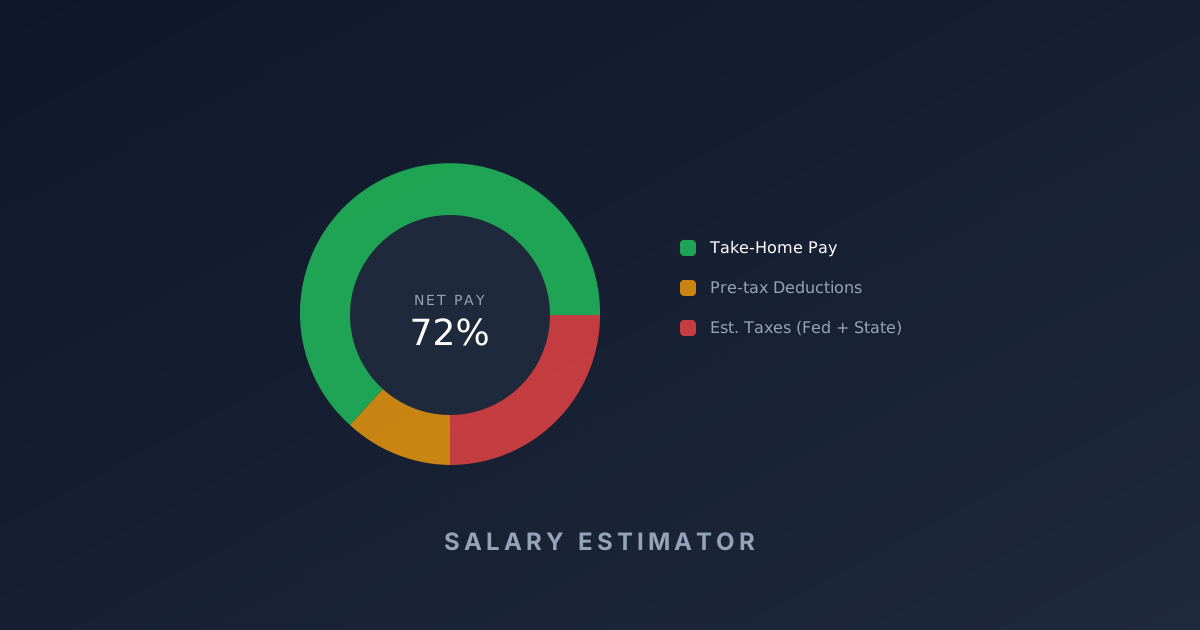
When you receive a job offer for $120,000 a year, it is easy to assume you will be taking home $10,000 a month. However, millions of American professionals experience a jarring reality check when their first direct deposit clears, and the number is substantially lower.
The gap between your "Gross Pay" (the headline number) and your "Net Pay" (your actual take-home cash) is governed by a complex web of federal taxes, state taxes, FICA contributions, and employer benefits.
If you want to truly master your household budget or accurately negotiate a new job offer, you must understand the mechanics of pre-tax deductions and marginal tax brackets. Here is the definitive guide to calculating your true earning power in 2026.
1. The Starting Line: Gross Pay
Your gross pay is your total compensation before the government or your employer touches a single cent. If you are a salaried W-2 employee making $120,000, your gross monthly pay is exactly $10,000.
2. The Power of Pre-Tax Deductions
This is the most critical and often misunderstood phase of paycheck calculation. Before federal and state income taxes are applied, certain deductions are subtracted from your gross pay. Because these are deducted before taxes, they legally lower your "taxable income," saving you thousands of dollars a year.
The "Big Three" pre-tax deductions are:
- Traditional 401(k) or 403(b) Contributions: Money diverted to these retirement accounts is tax-deferred.
- Health Insurance Premiums: Your share of the medical, dental, and vision insurance premiums deducted by your employer.
- HSA or FSA Contributions: Money set aside for qualified medical expenses.
The Math: Let's say your gross monthly pay is $10,000. You contribute $1,000 to your 401(k) and pay $200 for health insurance. Your new "Taxable Income" is now $8,800. The government will only calculate your income tax based on the $8,800 figure, not the full $10,000.
3. FICA Taxes (Social Security & Medicare)
FICA is a mandatory federal payroll tax that funds Social Security and Medicare.
- Social Security: 6.2% of your gross pay (up to the annual IRS wage base limit).
- Medicare: 1.45% of your gross pay (with no upper limit, plus a 0.9% surtax for high earners).
Unlike income tax, FICA is largely unaffected by your 401(k) contributions. You still pay FICA taxes on the money you send to your retirement account.
4. Federal and State Income Taxes
The US operates on a "progressive" federal tax system. This means your income is chopped into blocks, and each block is taxed at a progressively higher rate. You do not pay your highest "marginal" rate on every dollar you earn.
Furthermore, where you live heavily dictates your take-home pay. Living in a high-tax environment like California or New York will result in a significant state tax deduction. Conversely, living in an income-tax-free state like Texas, Florida, or Washington means you keep 100% of your state-level earnings, dramatically increasing your net cash flow.
5. The Bonus Trap: Supplemental Withholding
If your job includes an annual performance bonus or commission, prepare for "The Bonus Trap." The IRS classifies bonuses as "Supplemental Wages."
Employers typically withhold taxes on bonuses using the "Percentage Method," which legally requires them to withhold a flat 22% for federal taxes on any bonus under $1 million. When you add state taxes, Social Security, and Medicare, your bonus can easily face an upfront withholding of 35% to 40%.
Stop Guessing, Start Projecting
Manually calculating FICA limits, standard deductions, and progressive brackets is unnecessary. To instantly visualize your monthly cash flow, use the VANTIX Salary & Take-Home Pay Calculator.
By inputting your base salary, expected bonus, pre-tax deductions, and state tax environment, our algorithm processes the blended math for you. You will receive an immediate, highly accurate projection of your monthly net income, allowing you to budget, invest, and negotiate with total financial clarity.