How to Calculate Commercial Net Effective Rent (NNN & Free Rent Concessions)
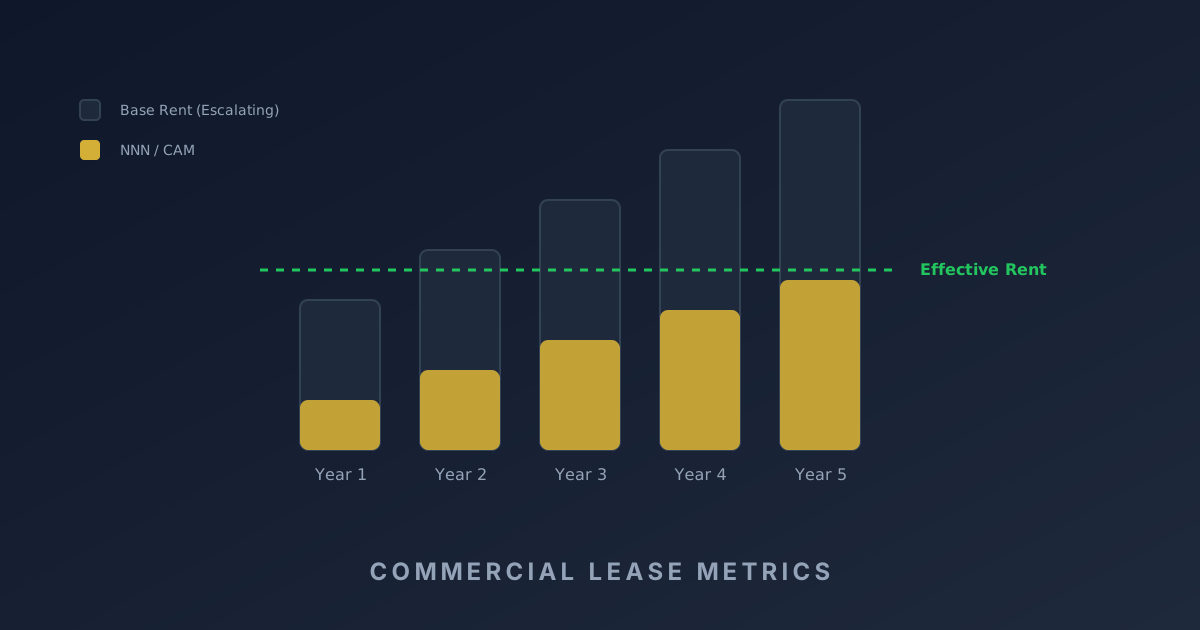
When hunting for a new commercial space—whether it is a retail storefront, a logistics warehouse, or a corporate office—the price listed on the broker’s flyer is almost never the amount you will actually pay.
Commercial real estate (CRE) is notorious for its complex pricing structures. Unlike residential leasing, where rent is a flat, all-inclusive monthly fee, commercial leases split the costs of the property into multiple moving parts. If a business owner budgets solely based on the advertised "Base Rent," they are highly likely to face a severe cash-flow crisis within their first year of operation.
To accurately compare two properties and protect your business’s runway, you must master the concept of Net Effective Rent.
The Illusion of Base Rent
Base Rent is the core cost to occupy the physical square footage of the building. It is usually quoted annually per square foot (e.g., $25/SF/Year). However, Base Rent does not cover the cost of actually running the building.
To find your true out-of-pocket costs, you must identify the lease structure. The vast majority of modern commercial spaces operate on a Triple Net (NNN) lease.
In an NNN lease, the tenant is legally responsible for paying the Base Rent plus their proportionate share of the building's three main operating expenses:
- Property Taxes
- Building Insurance
- Common Area Maintenance (CAM)
CAM charges are the most variable and often the most expensive. They cover the maintenance of shared spaces: parking lot repaving, landscaping, lobby electricity, security guards, and elevator repairs. If you lease 10% of the building’s total square footage, you will pay 10% of the building's total CAM and tax bills.
Why Landlords Offer "Free Rent"
To attract high-quality tenants without permanently lowering the building's Base Rent (which would devalue the property to investors), landlords frequently offer "Concessions." The most common concession is Free Rent (Rent Abatement).
A landlord might offer a 60-month lease at $5,000 a month, but give you the first 5 months completely free to help you cover the costs of building out your space.
This sounds like a great deal, but how do you compare it to a neighboring building offering $4,500 a month with no free rent? You have to calculate the Net Effective Rent.
Calculating Net Effective Rent (The Math)
Net Effective Rent is the true, average monthly cost of the space spread out over the entire duration of the lease, accounting for all free rent discounts.
The Example:
- Property A: 60-month lease. $5,000/month Base Rent. 5 Months Free.
- You pay $5,000 for 55 months = $275,000 total cash outlay.
- $275,000 ÷ 60 months = $4,583 / month Net Effective Rent.
- Property B: 60-month lease. $4,600/month Base Rent. 0 Months Free.
- You pay $4,600 for 60 months = $276,000 total cash outlay.
- $276,000 ÷ 60 months = $4,600 / month Net Effective Rent.
Even though Property A has a much higher Base Rent, the 5 months of free rent makes it the cheaper option over the long term.
(Important Note: During "Free Rent" periods, tenants are almost always still required to pay the NNN and CAM charges. The "free" only applies to the Base Rent).
Automate Your Real Estate Analysis
Navigating square footage multipliers, annual base rents, CAM estimations, and concession amortizations requires a flawless spreadsheet. One mathematical error can distort your financial projections by tens of thousands of dollars.
The VANTIX Commercial Lease Calculator is engineered specifically for tenants to cut through broker jargon. By inputting your square footage, Base Rent, estimated NNN/CAM charges, and any negotiated free rent periods, the algorithm instantly generates your Year 1 cash flow and your amortized Net Effective Rent.